Skip to content
Folk Whisperings
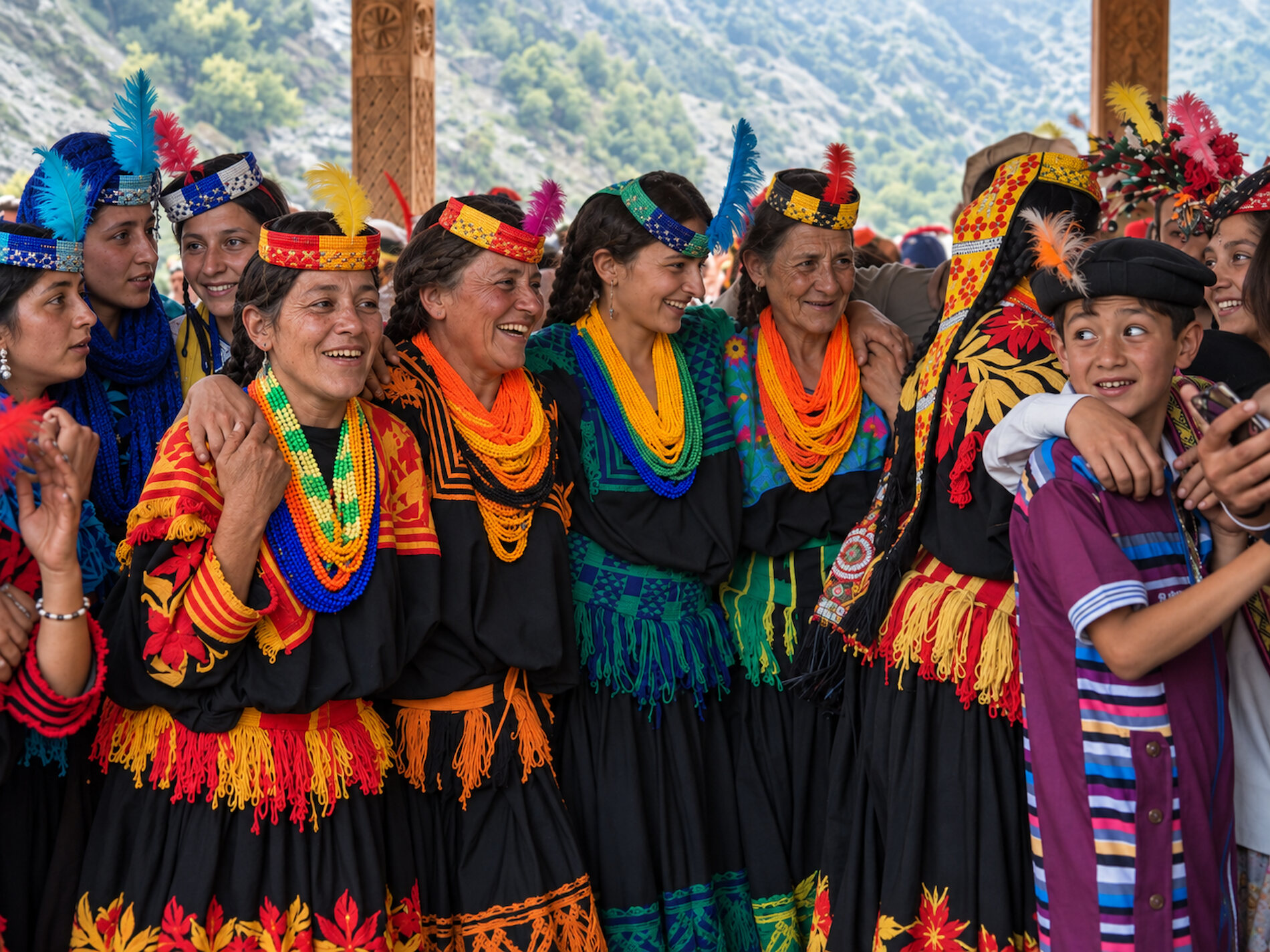
Kalasha women and children in beaded headdresses and ceremonial dress, gathered and laughing together
← All cultures

Kalash

Bumburet, Rumbur & Birir, Chitral

Three valleys, their own gods, and a calendar kept by the sun.

In three narrow valleys on the western edge of Chitral, the Kalasha keep a religion, a calendar and a language that belong to nowhere else. They are among the smallest distinct communities in Pakistan, numbering only a few thousand people, and the only one still practising an ancient polytheistic faith rather than Islam.

Their year is organised around the movement of the sun and the movement of the herds: up to the high pastures in summer, down to the valley floors before the snow. The festivals that mark those movements are not performances staged for visitors. They are the working structure of the year.

The land

Where this happens

The Kalasha valleys run west from the Chitral river towards the Afghan border, steep and forested, threaded with irrigation channels that have been maintained by hand for generations. Walnut and mulberry grow on the valley floors; the high pastures above the treeline carry goats through the summer. Space here is not neutral: parts of the valley are held to be onjesta, ritually pure, and others pragata, and the distinction shapes where people go and what happens there.
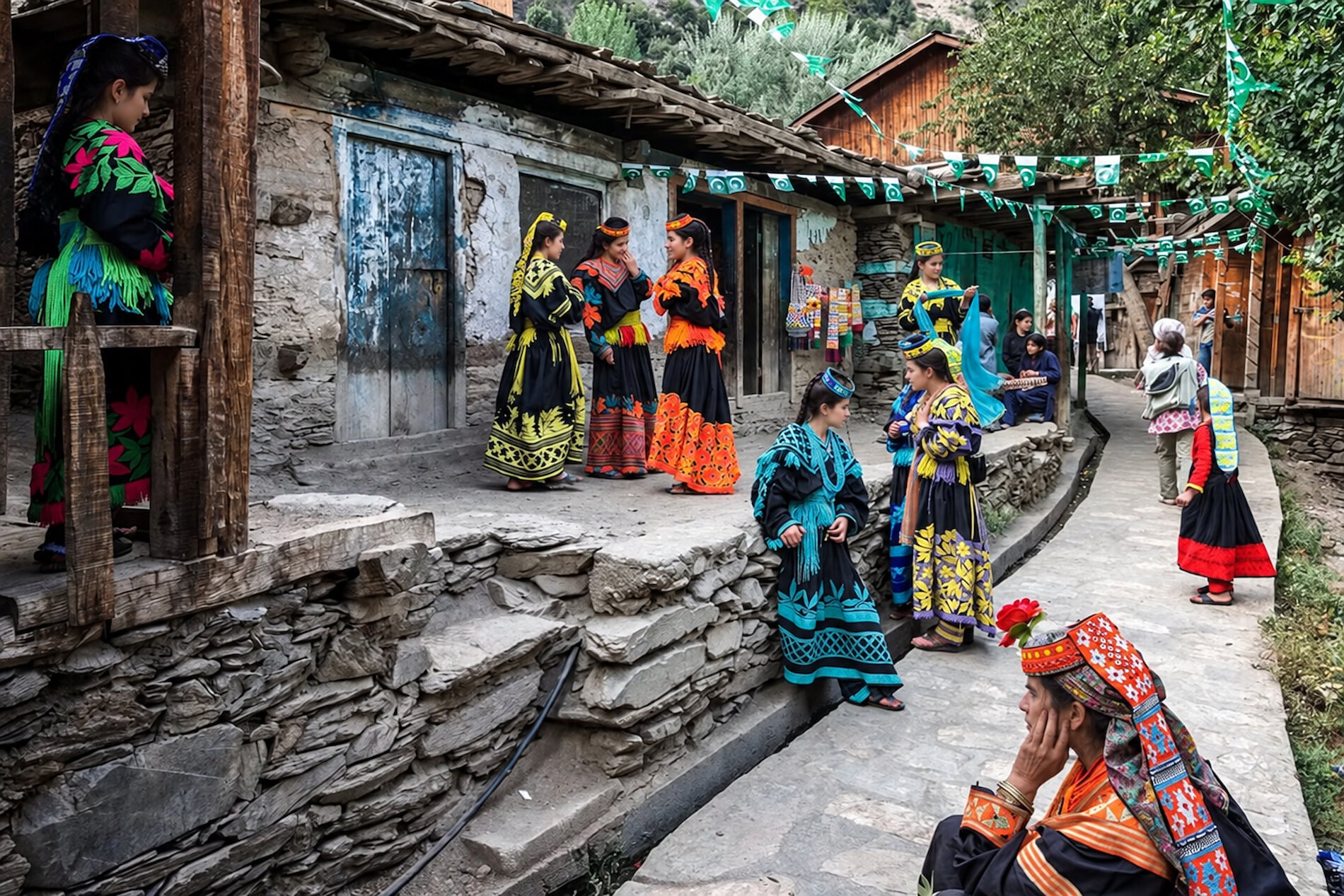
A stone-paved lane between wooden houses in a Kalasha valley settlement, women sitting along it

The language

One thread of many

Kalasha

Endangered
Family
Dardic branch of Indo-Aryan
Speakers
Roughly 3,000 to 5,000
Script
Historically unwritten; Latin- and Perso-Arabic-based orthographies have been developed in recent decades

Kalasha is closely related to Khowar, the language of the wider Chitral region, but is not mutually intelligible with it. Nearly all speakers are bilingual in Khowar or Urdu, and children increasingly use those languages first, the pattern that precedes language loss almost everywhere.

Sample vocabulary is deliberately absent. Words and pronunciations belong to speakers, and we will not publish them from memory or guesswork.

Traditions & festivals

The turning year

  1. Spring

    Chilam Joshi

    The spring festival, held as the herds are readied for the high pastures. Marked by dancing, and by the blessing of milk and of the flocks.

  2. Summer

    Uchal

    The harvest festival, celebrating the wheat and barley crop and the cheese brought down from the summer pastures.

  3. Winter solstice

    Chawmos

    The longest and most important festival of the Kalasha year, held around the winter solstice. Largely closed to outsiders, and the point at which the ritual year turns.

Craft, dress & music

Made by hand

Kalasha dress is the most immediately recognisable thing about the community, and the most misread. Women wear a long black robe worked with bands of embroidery, and one of two headdresses: the everyday shushut, and the tall ceremonial kupas, weighted with cowrie shells, beads and feathers. The bead necklaces worn in layers are not decoration alone: quantity, colour and arrangement carry meaning. Much of this is made by hand, by women, and the skills pass down without any formal instruction.

Gallery

In the valleys

Faces have been modified by AI to preserve anonymity.

What’s at risk

The pressures are not dramatic; they are cumulative. Young people leave the valleys for work and school. Conversion, road access, and the arrival of a tourist economy that pays for the appearance of tradition rather than its substance all pull in the same direction. The language is the first thing to go, and the ritual knowledge held by elders goes with it. Much of that knowledge has never been written down at all.

Support this work